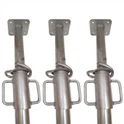
Hot Dip Galvanized Pipe
Hot-dip galvanizing (HDG), as referenced is the process of dipping fabricated steel into a kettle or vat of molten zinc.
Hot-dip galvanizing (HDG) is the process of coating iron, steel or ferrous materials with a layer of zinc. This done by passing the metal through molten zinc at a temperature of 860°F (460°C) to form zinc carbonate (ZNC03). Zinc carbonate is a strong material that protects steel and can prevent corrosion in many circumstances. Hot-dip galvanizing can be carried out cheaply and in large batches.
Benefits of galvanized pipe
Because the pipes are galvanized, it is protected from rust and corrosion. Steel rusts after interacting with water or moisture in the air over time. By adding a coating of zinc to the tubing, galvanized steel round tubing corrodes much slower, extending the life of your tubing.
In addition to this, galvanized pipe also provides:
Lower cost than stainless steel
Lowest long-term cost
Reliable performance
Excellent resistance to mechanical damage
Hot dipped galvanized with PE coating welded steel pipes
Galvanizing is one of the most widely used to methods for protecting metal from corrosion. It involves applying a thin coating of zinc to a thicker base metal, helping to shield it from the surrounding environment. The next time you are in your car, take a look at the street signs and lamp posts you pass. A large number of them will have a mute, silver color on them. That "silver" is actually the coating of zinc.
Thus, PE Coated Steel Pipes have been highly acclaimed even under severe environments such as areas of extreme cold, desert regions and under the sea.
Hot-dip galvanizing involves three main steps:
Preparation: The galvanizing reaction will only occur on a chemically clean surface, so the first step of the process involves removing contamination. First, the metal is degreased using a caustic solution and then dipped in hydrochloric acid to remove rust, mill scale, welding slag, paint and grease. This followed by a rinse and a dip in a flux solution, which is usually about 30 percent zinc ammonium chloride.
Galvanizing: When the clean iron or steel component is dipped into the molten zinc (at 842°F (450°C)), zinc-iron alloy layers form as a result of a metallurgical reaction between the iron and zinc. When the material is pulled from the galvanizing bath, a layer of molten zinc is present on top of the alloy layer. When it cools, it has the bright, shiny appearance associated with galvanized products.
Inspection: After galvanizing, the coated materials are inspected for coating thickness and coating appearance. A variety of simple physical and laboratory tests may be performed to determine thickness, uniformity, adherence and appearance of the zinc coating.
Different methods of galvanizing
There are several different processes for galvanizing metal:
1. HOT-DIP GALVANIZING
As the name implies, this method involves dipping the base metal into a molten pool of zinc. First, the base metal must be cleaned either mechanically, chemically, or both to assure a quality bond can be made between the base metal and the zinc coating. Once cleaned, the base metal is then fluxed to rid it of any residual oxides that might remain after the cleaning process. The base metal is then dipped into a liquid bath of heated zinc and a metallurgical bond is formed.
The advantages of this method are that it is economical; it can be performed quickly and to complex shapes. However, the final coating can be inconsistent relative to other galvanizing processes.
2. PRE-GALVANIZING
This method is very similar to hot-dip galvanizing but is performed at the steel mill, usually on materials that already have a specific shape. Pre-galvanizing involves rolling metal sheet through a similar cleaning process to that of the hot-dip galvanizing process. The metal is then passed through a pool of hot, liquid zinc and then recoiled.
An advantage of this method is that large coils of steel sheet can be rapidly galvanized with a more uniform coating compared to hot-dip galvanizing. A disadvantage is that once fabrication of the pre-galvanized metal begins, exposed, uncoated areas will become present. This means that when a long coil of sheet is cut into smaller sizes, the edges where the metal is cut are left exposed.
3.ELECTRO-GALVANIZING
Unlike the previous processes, electrogalvanizing does not use a molten bath of zinc. Instead, this process utilizes an electrical current in an electrolyte solution to transfer zinc ions onto the base metal. This involves electrically reducing positively charged zinc ions to zinc metal which are then deposited on the positively charged material. Grain refiners can also be added which helps to ensure a smooth zinc coating on the steel. Similar to the pre-galvanizing process, electrogalvanizing is typically applied continuously to a roll of sheet metal.