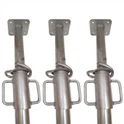
China is the world’s major steel exporter. In 2020, China’s steel exports totaled 53.67 million tons and the export value reached 454.7 billion U.S. dollars. The total export volume reached the world’s largest. All major economies in the world cannot leave China’s steel. However, Recently, some countries have started to suppress Chinese steel exports in an attempt to suppress China’s steel exports. First of all, let’s look at the UK. On August 9th, the British government announced that it would increase anti-dumping duties on some Chinese steel products in the next five years. , The rate reached 90.6%.
Coincidentally, according to my country’s Ministry of Commerce, Mexico announced not long ago that it will charge additional import fees for cold-rolled steel plates in my country. This measure is also for 5 years. Mexico has even adopted Different charging standards, such as 65.99% for products from Baosteel, 82% for Tangshan Iron and Steel, and even 103.41% for some steel companies in my country.
In addition to these two countries, Indonesia, the number one economy in Southeast Asia, is also preparing to start attacking Chinese steel. According to media reports, Indonesia’s steel production agreement has requested relevant departments to charge certain steel products imported by China. China’s anti-dumping duties, but the relevant authorities have not responded yet.
Chinese steel is extremely popular all over the world. The United Kingdom, the United States, Mexico, South Korea, Vietnam, Indonesia and other countries are all major exporters of Chinese steel. They all need China's steel very much, so why do they want to deal with China's steel?
The reason is that Chinese steel is so popular that local steel companies cannot compete with Chinese steel. Take Indonesia as an example. According to Silmy and Karim, President of the Indonesian Iron and Steel Association, Indonesia’s steel market has been occupied by Chinese steel. Relevant data shows that China's steel has become Indonesia's second-largest product in the first half of this year, most of which come from China. The import value is as high as 5.36 billion U.S. dollars, or about 34.7 billion yuan, an increase of 3.55 billion compared to the first half of last year. The U.S. dollar increased by 51.18% year-on-year. The reason for the increase is that the epidemic has passed, and infrastructure projects have begun, and the demand for steel has increased.
Indonesia’s local steel cannot compete with my country’s imported steel, which undoubtedly affects the interests of the country’s steel companies. In order to protect the production interests of domestic companies, import costs can only be increased through tax increases, thereby increasing the sales of domestic steel.
Mexico’s situation is exactly the same as that of Indonesia. China’s steel is too cheap to sell its own steel. In addition, this country has a special reason. When other countries around the world increase their demand for steel, Mexico’s demand has decreased. Mainly, the automobile industry has been hit too much by the epidemic, and it is still unable to fully recover. Relevant data shows that in July this year, the country's automobile production was only 220,000 vehicles, which was 73.5% of the same period last year. In the case of reduced steel demand In order to protect the country’s steel companies, Mexico’s increase in import taxes on Chinese-related products is also expected.
Increasing anti-dumping duties on Chinese steel companies can guarantee the interests of domestic steel companies to a certain extent, but it will also have some negative effects on domestic companies. Take Indonesia as an example, the decline in steel demand in this country and Mexico is just the opposite With the release of economic activity in Indonesia, the country’s construction market is continuously recovering, and the demand for steel is naturally rising. The market predicts that the country’s infrastructure demand for steel will reach 4 million tons. However, the total output of Indonesia’s steel plants is It is only 1.37 million tons, which is far from meeting the domestic demand. If too much anti-dumping duty is increased, the price of steel will naturally increase to a large extent, which will increase the cost of the construction industry and cause a huge impact on consumers and industry. Loss, which is not conducive to Indonesia’s economic recovery.
Will the actions of these three countries have an impact on China’s steel exports? There is definitely an impact, and perhaps it will reduce China’s steel exports to a certain extent, but in fact, my country does not care about it, and even welcomes it. Its success, why is this.
First of all, Chinese steel is not worried about selling. Instead, most countries urgently need Chinese steel. Now the global economy is recovering, and most countries’ demand for steel is increasing, causing the world to fall into a steel shortage. Take the United States as an example. Because of related infrastructure plans, the US demand for steel has increased to 100 million tons, while the annual output of steel in the US is only more than 80 million tons. Therefore, steel imports continue to be needed. However, due to the shortage of steel, the price of steel has skyrocketed. In May of this year, The price of steel in the US market is three times higher than the average level in the past 20 years.
When the global steel demand continues to rise, my country not only has no idea of expanding steel demand, but is also preparing to reduce production capacity and reduce exports. my country will take carbon neutrality as its goal in the future, and the steel industry is an industry with extremely high carbon emissions. Steelmaking will produce a lot of carbon dioxide and other greenhouse gases. For this reason, my country has been taking measures to reduce exports recently, such as raising export taxes on some steel products.
In addition, the export tax rebate for 23 types of steel will be cancelled. Recently, the China Iron and Steel Supply Association has also issued an initiative to export companies, hoping that relevant export companies can consciously control the total export volume, reduce the export of ordinary products, and increase the export of high-end products. While giving priority to meeting the needs of the domestic market, we will reduce exports accordingly. At present, some steel companies in my country have consciously reduced their steel output. A 6.6% decrease compared to the previous month.
China’s reduction in steel production and exports, coupled with other countries’ tax increases on Chinese products, did little harm to China, but it accidentally hurt the other two countries. The first is Australia. The raw material for steel production is iron ore. Australia’s iron ore is one of the country’s most important industries. At the same time, 40% of the country’s iron ore is imported into my country. However, after China’s steel production cuts, the demand for iron ore has naturally decreased. Relevant data shows , my country imported only 88.506 million tons of iron ore in July, a year-on-year decrease of 21.4%. Not to mention the decrease in Australian income, the price of iron ore has also fallen sharply.