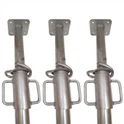
In the architectural and decorative applications of steel materials such as steel pipes, scaffolding, and steel prop supports, surface treatment processes for steel materials directly impact their service life, aesthetic appeal, and application scenarios. As three mainstream surface treatment technologies, galvanizing, powder coating, and painting each possess unique characteristics suited for different environmental requirements.
Galvanizing stands out as the preferred choice for outdoor structures due to its exceptional corrosion resistance. Powder coating finds extensive use in decorative components owing to its rich color options and eco-friendly properties. Meanwhile, painting meets short-term protection needs with its cost-effective advantages.
1. Galvanizing
(1)Principle: Forms a zinc layer on steel through electrochemical or hot-dip processes (common types: Hot-Dip Galvanizing/HDG, Electro-Galvanizing/EG).
(2)Corrosion Resistance: Zinc provides cathodic protection (sacrificial anode), offering exceptional durability (20–50 years outdoors).
(3)Appearance: Silver-gray matte finish, may exhibit zinc crystal patterns ("spangle").
(4)Hardness: Soft zinc layer (~250 HV), scratch-prone but self-heals minor damage.
(5)Applications:Outdoor structures (transmission towers, bridge railings), underground pipelines, marine environments.
(6)Cost: Medium to high (HDG > EG).
2. Powder Coating
(1)Principle: Electrostatic application of polymer powder (epoxy/polyester), cured under heat to form a plastic coating.
(2)Corrosion Resistance: Better than liquid paint but inferior to galvanizing; resists chemicals/UV (varies by powder type).
(3)Appearance: Wide color range (custom RAL codes), smooth or textured (e.g., sand, wrinkle finishes).
(4)Hardness: High (≥2H pencil hardness), abrasion- and impact-resistant.
(5)Applications:Indoor/outdoor equipment enclosures (cabinets, appliances), decorative components, mild corrosive environments.
(6)Cost: Low to medium (cost-effective for bulk production).
3. Liquid Painting
(1) Principle: Spray-applied solvent-based paint (acrylic, polyurethane, etc.), air- or oven-cured.
(2) Corrosion Resistance: Moderate; requires primer (e.g., epoxy + polyurethane topcoat) for enhanced protection.
(3) Appearance: Adjustable gloss (high-gloss/matte), but prone to drips and orange-peel texture.
(4)Hardness: Low (scratches easily), needs periodic maintenance.
(5)Applications:Temporary structures, indoor decor, low-budget corrosion protection.
(6)Cost: Low (but higher long-term maintenance costs).