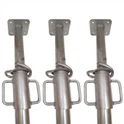
1. What is galvanized steel?
As per the given definition of galvanizing, we can understand galvanized steel as an object that the zinc-iron coating protects the base metal made from steel. The coating formed by the galvanizing process enhances the durability & strength of the steel itself by the corrosion protection. It also changes the steel’s appearance by giving it a rugged look. Overall, after going through the galvanizing process, the steel becomes stronger and harder to scratch and corrode; which makes it an ideal material for outdoor usage.
2. Which industry utilizes galvanized steel?
With its strong resistance to outside forces, galvanized steel is widely used in several industries such as construction, automotive, and telecommunication industry…
a. Construction industry
As a strong material that withstands corrosion and scratches, it’s no doubt that galvanized steel exists in almost all construction projects, whether it is for residential or commercial. Besides its durability, aesthetics and contemporary feel also make galvanized steel popular in modern architectural designs. Galvanized steel also becomes an essential part of small structure pieces, which are widely seen in your daily life such as fencing, rails, poles, tubing, cattle panels… (hyperlink vào cụm này nhé).
b. Automotive industry
Since the 1980s, many parts of cars & bikes have been made of zinc-coated metals. Up to 80% of the ‘raw body’ of a car is made using galvanized steel, which is a perfect marketing tool for the automotive industry. No one wants a scratch on their vehicles (that might cost a fortune), and galvanized steel handles it all.
c. Telecommunication industry
With billions of users and a huge demand for communication every single second, maintaining the phone lines is not something that a communication company prefers. Not to mention the inconvenience when the whole system is shut down, it’s also difficult to reach the lines as they are always hanging high. That’s why galvanized steel is also popular in the telecommunication industry. It can be found in phone wiring and equipment boxes which helps a lot in decreasing the risk of damage and the need for maintenance.
d. Wind & solar industries
With the need for energy skyrocketed in the past two decades, the energy crisis becomes a big problem for the human being. That’s why using sustainable energy such as wind & solar is now the key to solve the problem. However, wind and solar projects require a continuous workflow once installed, which means that no disturbance for maintenance is preferred as it means revenue loss. Hence, there is nothing more suitable than a strong and durable material such as hot-dipped galvanized steel. Thanks to its corrosion resistance and environmental friendliness (that it does not produce emissions), galvanized steel ensures decades without maintenance.
3. 06 useful advantages of galvanized steel
a. Ready to use (low initial cost)
In comparison to most treated steels, galvanized steel is more ready to use once delivered. There is no need for additional preparation, inspection, or treatment on the surface (such as painting/coating). Hence, you don't need to pay an additional fee aside from the cost of galvanized steel.
b. Low long term cost (less maintenance cost)
Thanks to its protective zinc coating, galvanized steel requires less maintenance than other untreated steels yet is still able to keep its good condition and appearance. That’s why galvanized steel is the cheapest material for the long term, even though there is an alternative coating whose initial cost is less. It’s in the case that additional costs for maintenance or replacement have yet to be counted.
c. Longer life
Galvanized steel lasts longer than most steels with different treatments for protection do, which is believed to be about 50 years in average environments. In severe and water-exposed conditions, galvanized steel is still able to withstand 20 years, without any maintenance required.
d. The zinc plays as a sacrificial anode
The fact that zinc plays as a sacrificial anode ensures that any damage will be handled by the surrounding coating. Come what may, the zinc coating is still the first to be damaged, and corrodes preferentially to the steel.
e. Rust resistance
Playing the role of a protective coating, the zinc prevents the steel underneath from exposing the moisture in oxygen. Hence, there is no chance for oxidation to occur and iron will not be converted into iron oxide.
f. Complete protection
Galvanized steel (especially when it comes to hot-dipped galvanization), even the sharp corners, recesses, and inaccessible areas are well protected by the zinc coating. Hence, galvanized steel provides complete protection that no other coating can.