Ask five suppliers for "galvanized steel pipe, 2 inch, 6 metre" and you will get five prices. Ask them what the zinc coating weighs and you will get five different answers in three different units - 275, 400, 60µm, Z275, "standard export quality" - and no two of them are describing the same thing.
Coating weight is the single most-specified and least-verified line on a galvanized pipe order. It is also where a large share of quality claims end up, because the buyer and the mill were measuring different properties under the same word.
This piece is about the arithmetic behind that number, why the four common standards disagree, and how to write a coating clause that a third-party inspector can actually enforce.
-The one conversion worth memorising
Zinc has a density of 7.14 g/cm³. That gives you a fixed bridge between the two units people quote:
1 µm of zinc = 7.14 g/m² of coating
So 400 g/m² is 56µm. 275 g/m² is 38.5µm. 60µm is 428 g/m². No conversion factor, no correction, just that one number.
The confusion starts one step later, and it is not a conversion problem at all. It is a question of how many surfaces the figure covers. Strip mills in the pre-galvanized world quote coating as the total on both sides. Hot-dip galvanizers measure one surface at a time. A Z275 sheet has 275 g/m² total, which is 137.5 g/m² per side, which is about 19µm per side - not 38µm. Half the "coating disputes" we see trace back to that factor of two, not to a mill cheating anybody.
-Four standards, four different products
This is where most sourcing conversations go wrong. ASTM A53, ASTM A123, ASTM A653 and EN 10346 are not four grades of the same thing. They describe two different manufacturing routes and four different minimums.
|
Standard |
Process |
Typical coating |
What it's for |
|
ASTM A53 |
Pipe formed and welded first, then hot-dipped |
Min. average 0.8 oz/ft² ≈ 245 g/m² ≈ 34µm |
Standard plumbing and mechanical pipe |
|
ASTM A123 / A123M |
Fabrication completed, then hot-dipped |
45µm min. average ≈ 320 g/m² |
Structural and fabricated steel, pipe assemblies |
|
ASTM A653 / A653M |
Coil coated inline at the strip mill, then formed into tube |
G90 = 275 g/m² total (≈19µm per side) |
Light-gauge tube, conduit, framing, fencing |
|
EN 10346 |
Same route as A653 |
Z275 = 275 g/m² total (≈19µm per side) |
European equivalent of the above |
|
ISO 1461 |
Hot-dipped after fabrication |
55–85µm mean depending on steel thickness |
General galvanized fabrication, widely cited in EU/ME tenders |
Note the pattern. A53 gets you roughly 34µm. A123 gets you 45µm and up. Pre-galvanized tube gets you 19µm per side. Those are not variations on a theme - they are a 2.5× spread in zinc, and they behave accordingly in service.
A supplier who quotes "galvanized to ASTM A53" against a buyer who meant "hot-dip to A123" is not lying. They are answering a different question, and the difference will not show up until the pipe is on site and someone puts a gauge on it.
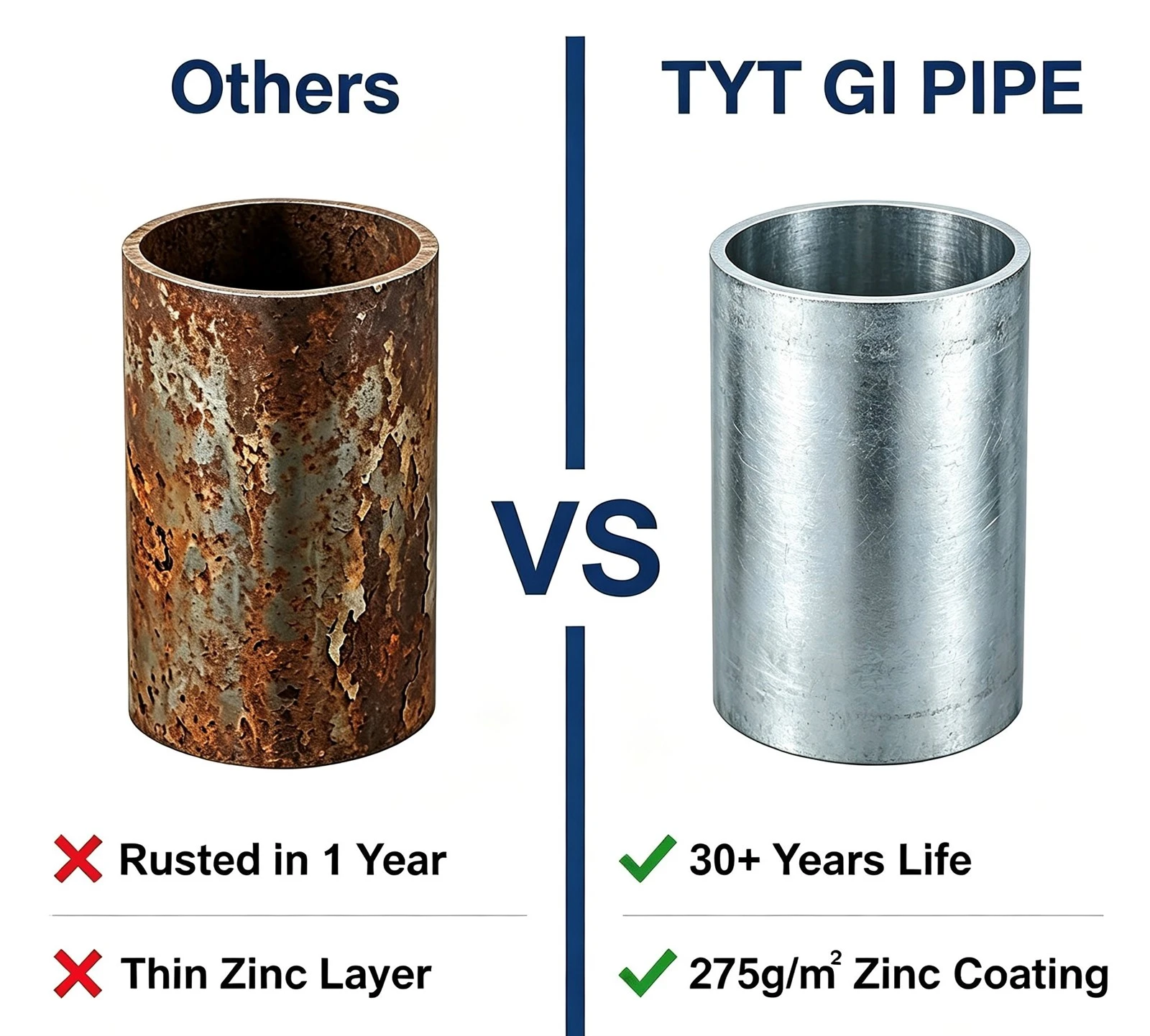
-Hot-dip after fabrication vs pre-galvanized coil: the seam
The process difference matters more than the thickness, and it is invisible in a spec sheet.
Pre-galvanized (A653 / EN 10346) starts as zinc-coated steel coil. The tube is formed and the longitudinal weld is made after coating. That weld burns the zinc off in a narrow band along the seam. Good mills run a zinc-rich repair over it; plenty do not, and the seam becomes the first place to rust. Cut ends and any drilled holes are bare steel, protected only by whatever is painted on afterwards.
Hot-dip after fabrication (A53 / A123) forms, welds and cuts the pipe first, then immerses the whole thing in molten zinc at around 450°C. Coating covers the seam, the ends and the inside bore. Threads, if they are cut before dipping, get coated too - which is why serious orders specify "threaded before galvanizing", since a thread cut after dipping exposes bare metal at the joint, exactly where moisture collects.
If your pipe is going into a wet or coastal application, this is the decision that matters. A 19µm pre-galvanized tube with an unsealed weld seam performs worse than a 34µm hot-dipped pipe, even though the first one's coating number looks competitive once you stop dividing by two.
-Why A53 pipe measures thin, and when that's fine
Buyers regularly complain that pipe ordered to A53 gauges at 30 to 40µm when they expected "hot-dip galvanized" to mean 70µm. That is not a defect. A53's coating requirement is genuinely modest - roughly 245 g/m² minimum average - because the standard is written for plumbing and mechanical service in sheltered conditions, not for a marine jetty.
A123 and ISO 1461 are the standards you want when the pipe is going outdoors, and the ISO 1461 minimum climbs with steel thickness: 45µm mean below 1.5mm, 55µm from 1.5 to 3mm, 70µm from 3 to 6mm, and 85µm at 6mm and above. A 4mm wall pipe therefore sits in the 70µm mean / 55µm local-minimum band. If you are writing a tender for a coastal project and you cite A53, you have specified a product that will fail your own durability expectation, and no inspection will save you.
One more thing nobody mentions until the claim arrives: the inside of a hot-dipped pipe usually carries less zinc than the outside. The bore drains differently as the pipe leaves the kettle, and coating builds unevenly at the bottom of the inside diameter. If your service is water-side, or if the pipe is for a condenser or a fire main, measure the inside separately. A certificate showing 500 g/m² on the outside tells you nothing about the surface that will actually see the water.
-How coating is really measured
Three methods, three different answers, and the one your inspector uses by default is the least accurate.
Magnetic induction (ASTM E376, ISO 2178). A gauge that reads coating thickness from the magnetic reluctance of the steel underneath. Fast, non-destructive, and the industry default. Its weakness is geometry: a flat-footed probe on a 2-inch pipe reads low because the curvature breaks contact and the field spreads. On small-diameter pipe you need a curved probe, or at minimum a correction factor, plus a zero check on an uncoated piece of the same pipe. We have seen 25% discrepancies between a flat probe and a gravimetric test on the same bundle.
Gravimetric strip test (ASTM A90, ISO 1460). Cut a measured area, weigh it, dissolve the zinc in acid, weigh again. The mass loss divided by area is the coating weight, no geometry involved. Destructive, slower, and the reference method when a number has to survive an argument. Any coating clause worth writing should name this method as the referee.
Cross-section microscopy. Polished mount under a microscope, coating measured directly. Used for failure analysis and for checking whether there is an alloy layer problem underneath the zinc.
Practical sampling, since this is where inspections get gamed: a minimum of five readings per pipe, on at least three pipes per bundle, from at least three bundles per lot, and readings taken away from cut ends and weld seams. Mills know inspectors take one reading near the end of a pipe, and that is exactly where the coating is thickest.
What the number buys you in service
Coating thickness is a corrosion budget, and it spends at a rate set by the environment. Under ISO 9223 categories, zinc loses roughly:
C2 (rural, low pollution): 0.1–0.7µm per year
C3 (urban, moderate industrial): 0.7–2.1µm per year
C4 (industrial, coastal): 2.1–4.2µm per year
C5 (marine, heavy industrial): 4.2–8.4µm per year
Run the numbers and the argument settles itself. A 55µm coating in a C3 city environment buys 25 to 75 years. The same 55µm pipe on a marine jetty in C5 spends its zinc in 7 to 13 years. Neither answer is "good" or "bad" in isolation - but if you are paying for 400 g/m² and shipping to a C5 site, 34µm is a maintenance liability with a date on it.
This is also why "how thick should the coating be" has no useful answer without a location and a service life target. Write the environment into the spec, and the thickness follows.
How to write a coating clause that holds
Most coating clauses fail because they specify a number without specifying how to verify it. Here is a formulation that has survived actual disputes:
Zinc coating shall be applied by the hot-dip process after fabrication, to ISO 1461 or ASTM A123 as applicable. Minimum coating mass: 400 g/m² average, determined by the gravimetric method of ASTM A90 / ISO 1460, on three samples per lot. No individual sample shall fall below 340 g/m². Magnetic gauge readings per ASTM E376 may be used for screening only and shall not be the basis of acceptance or rejection. Internal surface coating shall be measured and reported separately. Threads and cut ends shall be coated, or repaired with a zinc-rich coating of at least 90% zinc in the dry film.
Four things that clause does that a bare number does not: it fixes the process, it fixes the referee method, it sets a floor as well as an average, and it closes the thread and cut-end hole. Add a clause requiring the inspector to photograph the test location on each pipe and you have removed most of the room for creative sampling.
Two smaller items worth adding for pre-galvanized tube: require the weld seam to be repaired with zinc-rich coating and photographed, and specify that cut ends be coated or capped. Neither costs much. Both are the first things to fail.
The zinc is a real cost, and it shows in the price
Coating mass is not free, and the arithmetic explains a lot of suspicious quotations.
A 25-tonne lot of 2-inch SCH40 pipe has roughly 1,600 m² of total surface, inside and out. Add 100 g/m² across that area and you consume about 160 kg of zinc. At 2026 zinc prices in the low USD 3/kg range, that is around USD 500 of metal - about USD 20 per tonne of pipe, before you account for the extra kettle time and the slower line speed.
So when one supplier offers 80µm at the same price another quotes for 40µm, one of three things is happening: they are measuring a different surface, they are quoting a pre-galvanized number against a hot-dip requirement, or the pipe is thinner in the wall than you think and they are buying back the margin there. It is rarely free zinc.
FAQ
(1)Is 275 g/m² the same as 275 g/m²?
Only if both figures describe the same number of surfaces. Pre-galvanized strip is quoted as total on both sides, so Z275 is about 19µm per side. A hot-dip galvanizer measuring one surface would call the same coating 137.5 g/m². Always ask "per surface or total".
(2)How do I convert g/m² to µm for zinc?
Divide by 7.14. 400 g/m² is 56µm, 245 g/m² is 34µm, 55µm is 393 g/m². The factor comes from zinc's density of 7.14 g/cm³ and does not vary between standards.
(4)Which standard should I specify for outdoor galvanized pipe?
ASTM A123 or ISO 1461, not A53. A53's minimum of roughly 245 g/m² is written for sheltered plumbing and mechanical service. For coastal or industrial exposure, specify the ISO 1461 thickness band for your wall thickness and verify it gravimetrically.
(5)My gauge reads 35µm but the mill certificate says 400 g/m². Who is wrong?
Possibly neither. A flat probe on small-diameter pipe reads low because of curvature, and a certificate may report an average from a different location. Re-test with a curved probe and a zero check, then settle it with an ASTM A90 strip test before you reject a container.
(5)Does thicker zinc always mean better pipe?
No. A 100µm coating on a pipe with a thin wall, a bad weld or an unsealed thread is still a bad pipe. Coating protects the surface; it does not compensate for dimensional or welding defects. Judge the whole specification, not one number.
Why is the inside of my galvanized pipe rusting first?
Because the bore carries less zinc than the outside - it drains unevenly as the pipe leaves the kettle - and because condensate sits there. If the service is water-side, specify and measure internal coating separately, and consider a lining rather than relying on zinc alone.
Bottom line
Zinc coating is a number with three moving parts: the unit, the number of surfaces, and the standard behind it. Get those three straight before you compare a single quotation, and most coating disputes disappear before they cost anybody a container.
Then write the clause so it can be tested, name the gravimetric method as the referee, and measure the inside as well as the outside. The pipe that fails in year four is almost never the one that was specified badly. It is the one that was specified vaguely and inspected generously.
✅ Supported trade terms: FOB, CIF, DDP
💬 Feel free to reach out with your inquiry for a tailored quote!