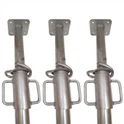
Jack posts are telescopic tubular steel props consisting of two primary parts, the main part of the post, and the jack screw or other adjustable fitting on one or both ends. Both ends are normally fitted with flat metal plates on the end, providing additional support area. A recent improvement to Acrow props was to shape this baseplate with notches, allowing pallet loads of horizontal props to be stacked neatly, rather than randomly piled.
Most jack posts are split in two near the middle, with the upper end carrying the jack designed to slide within the lower portion. Gross adjustment for length is first made by pulling a pin and sliding the two sections within each other until they almost fill the gap, inserting the pin to lock them, then using the screw to close any remaining gap. Other designs used two threaded pipes instead of sliding sections, ratechetting or clamping sections, or other similar concepts to lock the system at a specific length.
Jack posts are mostly used for shoring: temporary supports during building repair or alteration work, rather than scaffolding: access platforms for workers. A typical use is to support an existing horizontal beam while its original masonry supports are removed or repaired. When masonry itself is to be supported, holes are first knocked through the brickwork and a strong 'needle' or 'strongboy' is placed through the hole. A pair of props are then used, one under each end. Existing windows or doorways may also be supported directly, or via needles. As the plates on the end of the posts are typically small, they offer little sideways support. If there is any sideways force, props should be strutted or 'laced' with scaffolding poles.
A shoring prop could be a stout piece of timber, and indeed it was until the beginning of the second world war.
These days, shoring props are usually telescopic props, usually made of tubular steel, with flat plates fitted to the outer ends, and a robust nut and pin arrangement in the middle for length adjustment. The typical arrangement is that of the Acrow type, named by its inventor, Swiss emigrant to England, William de Vigier. It was named after his solicitor (and presumably venture capitalist) Mr A Crowe.
A shoring prop is used for exactly that. Shoring. I would not call it scaffold (since scaffold is used for supporting people.)
Shoring is the temporary means to prevent collapse of materials or elements whilst building, rectifying, or at other times.
Following is a prop under test in my laboratory (with the chair of the Australian Standard committee for both formwork and scaffold and several other matters in the background).