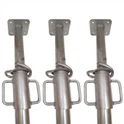
Scaffolding, also called scaffold or staging, is a temporary structure used to support a work crew and materials to aid in the construction, maintenance and repair of buildings, bridges and all other man-made structures. Scaffolds are widely used on site to get access to heights and areas that would be otherwise hard to get to. Unsafe scaffolding has the potential to result in death or serious injury. Scaffolding is also used in adapted forms for formwork and shoring, grandstand seating, concert stages, access/viewing towers, exhibition stands, ski ramps, half pipes and art projects.
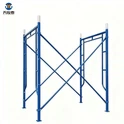
There are five main types of scaffolding used worldwide today. These are Tube and Coupler (fitting) components, prefabricated modular system scaffold components, H-frame / facade modular system scaffolds, timber scaffolds and bamboo scaffolds
Scaffolding was erected by individual firms with wildly varying standards and sizes. The process was revolutionized by Daniel Palmer Jones and David Henry Jones. Modern day scaffolding standards, practices and processes can be attributed to these men and their companies: Rapid Scaffold Tie Company Ltd, Tubular Scaffolding Company and Scaffolding Great Britain Ltd (SGB).
David Palmer-Jones patented the "Scaffixer", a coupling device far more robust than rope which revolutionized scaffolding construction. In 1913, his company was commissioned for the reconstruction of Buckingham Palace, during which his Scaffixer gained much publicity. Palmer-Jones followed this up with the improved "Universal Coupler" in 1919 - this soon became the industry standard coupling and has remained so to this day.
Advancements in metallurgy throughout the early 20th century saw the introduction of tubular steel water pipes (instead of timber poles) with standardized dimensions, allowing for the industrial interchangeability of parts and improving the structural stability of the scaffold. The use of diagonal bracings also helped to improve stability, especially on tall buildings. The first frame system was brought to market by SGB in 1944 and was used extensively for the postwar reconstruction.
Good foundations are essential. Often scaffold frameworks will require more than simple base plates to safely carry and spread the load. Scaffolding can be used without base plates on concrete or similar hard surfaces, although base plates are always recommended. For surfaces like pavements or tarmac base plates are necessary. For softer or more doubtful surfaces sole boards must be used, beneath a single standard a sole board should be at least 1,000 square centimetres (160 in2) with no dimension less than 220 millimetres (8.7 in), the thickness must be at least 35 millimetres (1.4 in). For heavier duty scaffold much more substantial baulks set in concrete can be required. On uneven ground steps must be cut for the base plates, a minimum step size of around 450 millimetres (18 in) is recommended. A working platform requires certain other elements to be safe. They must be close-boarded, have double guard rails and toe and stop boards. Safe and secure access must also be provided.