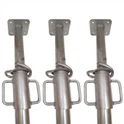
Steel pipes are cylindrical tubes made from steel that are used many ways in manufacturing and infrastructure. They’re the most utilized product made by the the steel industry. The primary use of pipe is in the transport of liquid or gas underground—including oil, gas, and water. However, pipes of varying sizes are used throughout manufacturing and construction. A common household manufacturing example is the narrow steel pipe that runs the cooling system in fridges. Construction uses pipes for heating and plumbing. Structures can be built using steel pipe of varying sizes, such as handrails, bike racks, or pipe bollards.
William Murdoch is thought to be the pioneer of steel pipes. In 1815, he joined barrels of muskets together to support a coal lamp burning system. Murdoch used his innovative piping system to transport coal gas to lamps on the streets of London.
Since the 1800s, great strides have been made in the technology of steel pipes, including improving manufacturing methods, developing applications for their use, and the establishment of regulations and standards that govern their certification.

HOW IS STEEL PIPE MADE?
From melting raw materials to molding or welding, this ubiquitous building material is created through two main processes:
Convert raw steel to a more usable form
Both processes must start by making good quality steel. Raw steel is produced by foundries through a process of melting raw materials in a furnace. To get the composition exactly right, elements may be added to the molten metal, and impurities removed. The resulting molten steel is poured into molds to make ingots or is transferred to a continuous casting machine to make slabs, billets, and blooms. Pipe is made from two of these products: slabs or billets.

Steel slabs and steel skelp in pipe manufacturing
Steel skelp is made from slabs that are heated to 2,200˚F. The heat causes a scale to form on the surface, which must be removed through a scale breaker and high pressure cleaning. Once cleaned, the steel slab is hot rolled into thin, narrow strips of steel called skelp. Skelp is pickled (surface cleaned) with sulfuric acid, washed with water and rolled onto large spools as the raw material for pipe making. The width of the skelp determines the diameter of the pipe that can be made.
Skelp is unwound from the spool, heated, and rolled through grooved rollers, which bend the edges of the skelp upwards. This process produces a cylindrical tube where the two edges have been bent right around to meet each other forming a long cylinder. A welding process joins the edges together and seals the pipe.
In a continuous welding operation, welding rollers press the edges of the pipe into each other—forming a forged weld due to the heat that has already been applied to the skelp. No metal is added during welding, and the final rollers reduce the diameter and wall thickness of the pipe to the specifications.
Electric resistance welding follows a similar process to continuous welding, except that the skelp is cold rolled into the pipe shape. Current is supplied to the pipe edges by revolving copper disks, which heat the edges up to the weld temperature. Welding rollers join the pipe edges to create a forged weld.
Spiral welding and double submerged arc welding use more conventional welding techniques and add weld material to form the bond.
Steel billets for seamless pipe
Steel billets are long square pieces of steel produced directly from a continuous casting machine or as a secondary product made from rolled and stretched cast ingots. These billets can be used to make seamless pipe, which is safer in some applications for not having a weld line.
The solid steel billet must be heated extreme temperatures, becoming white hot but not melted. Machines roll them so that they become a cylindrical solid. While still hot, a bullet-shaped piercer is used to make the hollow center regular according to its dimensions. A series of milling operations follow to conform the pipe to the required specifications.
Finishing steps
Pipes may be put through a straightening machine as a final process step before being fitted with joints at the end. Small bore piping is usually fitted with threaded joints, but larger bore piping is normally fitted with flanges that are welded onto the end of the pipe. Measuring machines check the dimensions of the finished pipe, and stamp the details on the side of the pipe for quality control purposes.
Quality control
Quality control steps include checking the pipe for defects using x-ray machines—especially along the weld. Another technique is to pressure test the pipe by filling it with water, then holding it under pressure for a specified time to expose any defects that may cause catastrophic failure before it is put in service.
HOW IS STEEL PIPE USED?
Pipes are used in structures, transportation, and manufacturing. They are sized according to their outer diameter, with the inner diameter varying based on wall thickness. Some applications need thicker walls than others, depending on the forces the pipe must manage.
Structural use
Structural uses are common building and construction. In these industries, the building material is commonly referred to as steel tubes.

Construction piles
Steel tubes provide strength to foundations in a process called piling. In these applications, the tube is driven deep into the earth before the foundation is laid. It provides stability for a high building or construction on ground that is not secure.
There are two fundamental types of pile foundations:
End bearing piles have the bottom end resting on a layer of especially strong soil or rock. The load of the building is transferred through the pile onto the strong layer.
Friction piles transfer the load of the building to the soil across the full height of the pile, by friction. The entire surface of the pile helps to transfer the forces to the soil.

Scaffolding poles
Scaffolding poles are made by linking steel tubes in a cage that allows construction workers to access areas high above ground level.
Manufacturing use

Guard rails
Guard rails are also made from steel tubes, creating an aesthetically pleasing safety feature to stairs and balconies.

Bollards
Security bollards are used to cordon off an area from vehicle traffic to protect people, buildings, or infrastructures.

Bike racks
Many commercial bike racks are formed by bending steel tubes. The tough material properties of steel make it secure against thieves.
Transport use
The most common use of steel pipes is for the transport of products because the material is well suited for long-term installations. It can be buried underground due to its hardiness and resistance to breakdown.
Low pressure applications do not require pipes to have high strength since they are not exposed to significant stresses. Narrow wall thickness allows for cheaper manufacture. More specialized applications—such as pipes used in the oil and gas industry—require more stringent specifications. The hazardous nature of the product being transported, and the possibility of increased pressure on the line, demands high strength and therefore higher wall thickness. This generally brings an associated higher cost. Quality control is critical for these applications.

HOW IS STEEL PIPE SPECIFIED?
There can be confusion about the way these materials are specified, and what the means to the exact characteristics of the pipe. The American Society for Testing and Materials (ASTM) along with The American Society of Mechanical Engineers (ASME) and the American Petroleum Institute (API) are the most referenced organizations for piping specifications in North America.
Specifications can be broken down into three main categories:
Nominal pipe size
Pipe size is quoted as a “Nominal Pipe Size” or NPS. The origin of the NPS numbers for smaller pipes (< NPS 12) is different to the origin for larger diameter pipes. However, all pipes of a specific NPS number have the same external or outer diameter (OD). The internal diameter will vary depending on the wall thickness of the metal. The reason for this is so that the same structural supports can be used for all piping of a specific NPS number regardless of the wall thickness.
Schedules
Steel pipe schedules are a way to describe the wall thickness of the pipe. This is a critical parameter as it is directly related to the strength of the pipe and the suitability for specific applications. A pipe schedule is a dimensionless number and is calculated based on the design formula for wall thickness, given the design pressure and allowable stress.
Examples of schedule numbers are as follows: 5, 5S, 10, 20, 30, 40, 50, 60, 80, 100, 120, 140, 160, STD, XS, and XXS—with the most common being schedules 40 and 80. As the schedule number increases, the wall thickness of the pipe increases. The schedule number of a pipe therefore defines the internal diameter, as the OD is fixed by the NPS number.
Pipe weight
The weight of a pipe can be calculated based on the NPS, which defines the outer diameter, and the schedule, which defines the wall thickness. The formula uses the theoretical weight of steel of 40.8 pounds per square foot per 1 inch of thickness to determine the constant.
W = 10.69 x t (OD – t)
Where:
W = weight (in pounds per foot)
OD = outer diameter
t = thickness
The following table from Engineering Toolbox shows the measurements of OD, wall thickness, and weight for pipes of different NPS. Both schedule 40 and schedule 80 measurements are shown.
CERTIFICATION
Manufacturers issue a Material Test Report, or Mill Test Report, to validate that the product meets the chemical analysis and mechanical properties specification. The MTR will contain all relevant data to the product and will accompany the product through its lifecycle.
The following are typical parameters that may be recorded on an MTR:
Chemical composition including carbon content, alloys, and sulfur
Material size, weight, identification, and grade
Material heat number, which ties back to the processing batch
Mechanical properties like tensile strength, yield strength, and elongation
For steel bollards, the most common specifications cited are ASTM A53 and ASTM A500.
HOW DOES RELIANCE FOUNDRY USE STEEL PIPES?
Reliance Foundry supplies pipe bollards that are made from steel pipes. Bollards are vertical pipe lengths installed in the ground to protect people, buildings, and surrounding infrastructure from vehicle collisions.
Steel pipe bollards must conform to safety specifications to ensure they are strong enough to resist the impact of vehicle collisions. Schedule 40 and schedule 80 steel can be used to make steel pipe bollards depending on the application.
Steel pipe bollards are often covered with stainless steel, plastic, or other metal decorative covers for aesthetic appeal and to protect the steel pipe from corrosion.