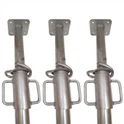
A tube and coupler scaffold has a platform(s) supported by tubing, and is erected with coupling devices connecting uprights, braces, bearers, and runners (see Fig. 1). Due to their strength, these scaffolds are frequently used where heavy loads need to be carried, or where multiple platforms must reach several stories high. These scaffolds can be assembled in multiple directions, making them the preferred option for work surfaces with irregular dimensions and/or contours.
Scaffold Planning Review blueprints, work orders, the project schedule and other written requirements to determine where these scaffolds should be used. Next, select the right size scaffold for each job. Scaffolds are generally rated as light, medium or heavy duty. Light-duty scaffolds can support a limited number of workers and hand tools (25 lbs. per sq. ft.). Medium-duty scaffolds must be able to safely hold workers, hand tools, and the construction materials being installed (50 lbs. per sq. ft.). Heavy-duty scaffolds must support workers, tools and the weight of stored materials
The following factors should be considered in the planning phase:
• The shape and structure of the building to be scaffolded.
• Distinctive site conditions and any special features of the building structure in relation to the scaffold (i.e., overhead electric power lines or storage tanks). Also consider the proximity and condition of surrounding buildings.
• Weather and environmental conditions.
• Fall protection requirements for workers using scaffolds, such as guardrail systems or personal fall arrest systems.
• The type and amount of scaffold equipment needed to access all areas to be worked on.
• Proper storage and transporting of scaffolding components, materials and equipment.
• The manner in which workers will access the scaffold (i.e., via ladders, stair rail systems, etc.).