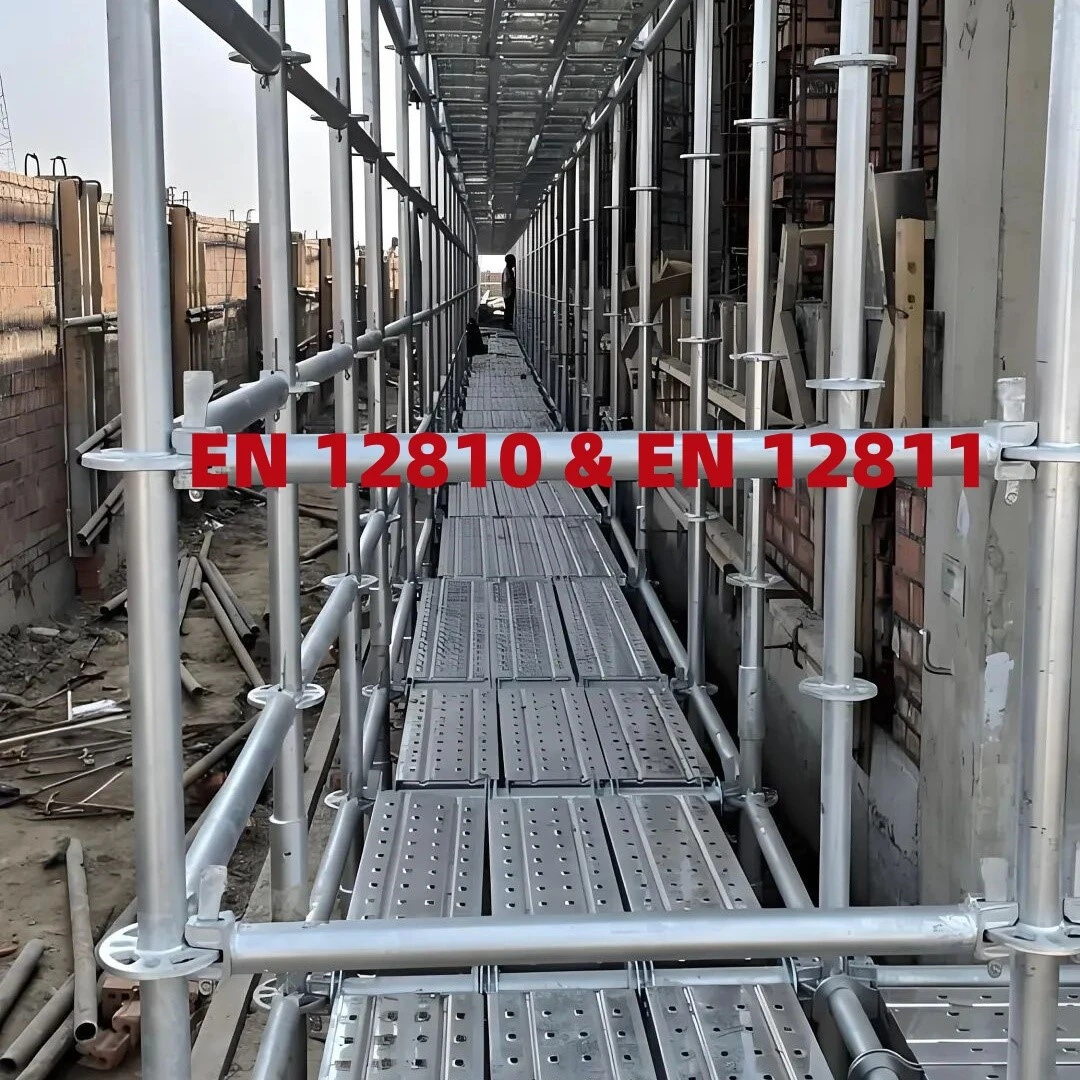
If you export scaffolding products to Europe or participate in engineering projects in the EU, EN 12810 and EN 12811 are two fundamental standards you cannot bypass. These two standards form the complete technical framework for the EU's requirements on scaffolding performance and structural design, and serve as the entry pass for products to obtain CE certification and access the European market.
However, many Chinese scaffolding manufacturers and exporters have widespread misunderstandings about these two standards:
❌ Mistakenly believing that "obtaining CE certification equals compliance with EN 12810/12811"
❌ Confusing the difference between "performance standards" and "design standards"
❌ Unclear how the Class rating is linked to specific products
❌ Unfamiliar with details of test items and sampling rules
1. What is the relationship between EN 12810 and EN 12811?
This is the first question for many readers. In fact, the two are complementary and jointly form a complete technical specification system for scaffolding:
EN 12810 focuses on "whether the product itself is qualified" (product level)
EN 12811 focuses on "how to calculate the safety of the overall structure" (engineering level)
Combined, they cover the complete quality control chain from raw materials → components → systems → overall structure.
2. Core Interpretation of EN 12810-1: What Do the Performance Requirements Entail?
EN 12810-1 is the product-level master specification of European scaffolding standards. Its core question is: "What performance indicators must a qualified prefabricated facade scaffolding system meet to be compliant?"
EN 12810-1 adopts a Performance-Based Approach: it does not mandate specific materials or structures, only the final performance that the product must achieve, and compliance is granted as long as the performance meets requirements. This concept is more flexible, but also puts forward higher requirements for enterprises' technical understanding capabilities.
Scope of Application
EN 12810-1 mainly targets prefabricated facade scaffolding, i.e. scaffolding systems with factory-standardized production and on-site assembly. It covers most export categories including ringlock, cuplock, frame, and modular systems, but does not apply to traditional fastener-type steel pipe scaffolding and special-shaped scaffolding. This definition makes the application scope of the standard very clear, and avoids confusion between different systems.
6 Core Performance Dimensions
EN 12810-1 covers six key requirement dimensions:
Geometry and structural requirements: It stipulates that basic parameters such as upright spacing, ledger step distance, and working platform width must be within a reasonable range to ensure basic system usability.
Structural strength requirements (core of the standard): It requires that rods and connecting nodes (such as rosettes, cuplocks, and clamps) must have sufficient tensile, compressive, bending, and torsional resistance, and this performance must be verified through standardized tests.
Stability requirements: It emphasizes that the entire frame must not suffer from overall instability or overturning under the combined action of self-weight, live load, wind load, etc.
Load-bearing capacity requirements (most distinctive feature): It divides working platforms into 6 Class ratings (Class 1 to Class 6) according to load-bearing capacity, with corresponding uniform loads increasing step by step from 0.75 kN/m² to 6.0 kN/m², and a uniform concentrated load of 1.5 kN. Enterprises can flexibly choose the matching grade according to different application scenarios.
Durability requirements: The standard has clear regulations on anti-corrosion treatment: the average thickness of the hot-dip galvanized coating shall not be less than 55 microns, and the local thickness shall not be less than 45 microns, and corrosion resistance shall be verified through a salt spray test.
Operational safety requirements: The standard has detailed regulations on guardrails, toe boards, platform planks, fall prevention designs, etc., to ensure the personal safety of workers during operation.
Key Highlight: Class Grading System
Among all requirements, the Class grading system of EN 12810-1 is most worthy of in-depth understanding by Chinese export enterprises. The standard forms an identification system similar to a "product ID card" through the combination of three dimensions:
Upright spacing (SW for small spacing or LW for large spacing)
Load class (Class 1-6)
Platform protection configuration (4 grades from H0 to H3)
Every compliant product must have a complete Class code, which must be permanently and clearly marked on the product nameplate. For example, a common high-end configuration "3D - SW06/250 - H2 - B" means: load Class 3 (corresponding to 2.0 kN/m²), upright spacing of 2.5m, working platform width of 0.6m, platform protection configuration H2 (double ledgers plus toe board), and special function B.
This "code equals rating" concept essentially elevates scaffolding, traditionally regarded as a "general construction tool", to the level of traceable, comparable, and verifiable engineering components.
The real value of EN 12810-1's performance-based standard is to break technical barriers between European countries, allow objective comparison of products from different manufacturers under unified rules, and encourage innovation: as long as you can prove product performance meets requirements, you can sell in the European market regardless of the materials and structures you use.
3. Core Interpretation of EN 12811-1: How to Conduct Structural Design Calculations?
If EN 12810 focuses on "whether the scaffolding product is qualified", EN 12811-1 focuses on "how to calculate the scaffolding structure to ensure safety". It is the methodological basis for European scaffolding design, and is essentially a set of technical language for Limit State Design, which has a fundamental conceptual difference from the allowable stress method specified in China's current JGJ 202 standard.
Core Logic: 3 Load Types + 5 Limit States + 1 Set of Verifications
3 Load Types: Designers must systematically consider three types of actions and conduct superposition calculation according to the principle of unfavorable combination:
Permanent loads: Time-invariant parts such as scaffolding self-weight, platform plank weight, guardrail weight
Variable loads: Dynamic loads such as workers, stacked materials, construction equipment (divided into 6 grades from 0.75 to 6.0 kN/m² according to Class 1 to Class 6)
Environmental loads: Wind load, snow load, temperature effect
5 Limit States to Verify:
Ultimate limit state of bearing capacity: The structure must not be damaged or unstable
Serviceability limit state: Deformation and deflection must be within acceptable range (platform deflection shall not exceed 1/100 of the span)
Overturning limit state: Overall anti-overturning stability coefficient shall not be less than 1.5
Sliding limit state: No slippage between the bottom foundation and the ground
Fatigue limit state: Fatigue checking calculation for connecting nodes subjected to repeated loads
This multi-state verification concept can more truly reflect the actual safety margin of the structure compared with the traditional allowable stress method.
Key Design Constraints
EN 12811-1 gives clear reference parameters: upright spacing is usually between 1.0m and 3.0m, ledger step distance is generally 1.5 to 2.0m, the eccentricity between the working platform and the wall shall not exceed 100mm, the spacing of tie members along the vertical direction shall not exceed 4m and along the horizontal direction shall not exceed 6m, and the number of simultaneously operating floors is assumed to be no more than two.
These parameters jointly determine the calculation model of the entire frame: uprights are simplified as continuous compression bars with elastic supports, tie members are regarded as horizontal spring supports, wind loads are converted into lateral forces distributed along the facade, and overall stability is finally solved through second-order elastic analysis or the P-Δ method.
Key Notes for Practice
The most easily overlooked yet most critical clauses of EN 12811-1 are anti-overturning checking calculation and overall stability verification. Many Chinese enterprises' products perform excellently in single-component tests under EN 12810-2, but expose problems in high-rise applications above 50m when checked against EN 12811-1: the higher the height, the more significant the wind load amplification effect, and the effective length factor of uprights changes accordingly. The overall instability mode may shift from "member instability" to "frame lateral displacement instability", which cannot be captured by single component tests.
This is also why European Notified Bodies (such as TÜV, DIBt) not only review product reports during audit, but also require design calculation documents and whole frame verification reports under typical working conditions. The real value of EN 12811-1 is that it forces designers to move from "single-point qualification" to "system safety" - this is not only a test of products, but also a test of design capabilities.
4. 4 Common Questions and Misconceptions
Q1: Is EN 12810 certification mandatory for ringlock scaffolding?
✅ Answer: Yes. All prefabricated scaffolding systems sold in the European market must comply with EN 12810/12811 and carry the CE mark.
Q2: Is the higher the Class rating, the better?
✅Answer: Not necessarily. A higher Class rating means higher self-weight and higher cost. It should be selected according to the actual load demand of the project, and over-design is a waste of resources.
Q3: If customers outside the EU request EN 12810 reports, can we provide them directly?
✅ Answer: Yes. EN standards are adopted by many countries (such as Switzerland, Norway, and countries in the Middle East), and many projects in the Middle East and Southeast Asia also require EN standard compliance.
Q4: How often are the standards updated?
✅ Answer: EN standards are usually revised every 5-10 years. Some clauses have been updated after 2020, it is recommended to refer to the latest version on the official CEN website.
Contact us for professional scaffolding solutions tailored to your specific needs.