Most buyers open this question with one assumption built in: that there is a standard to choose from. There isn't. There are three, stacked on top of each other, and they answer completely different questions.
Export orders rarely fail because the buyer picked the wrong standard. They fail because he fixed one layer and left the other two to the supplier's default. The supplier's default is always the cheapest interpretation that still passes inspection.
So before comparing A53 against EN 10255, separate the three layers. This single step removes most of the disputes that reach the claim stage.
Layer 1, the product standard: dimensions, steel, tests
This is what people mean when they say "which standard". It fixes the outside diameter, the wall thickness table, the allowable wall tolerance, the yield and tensile requirements, the hydrostatic or eddy-current test, and the marking on the bundle.
What it does not fix is how much zinc sits on the surface. A53 mentions a coating figure, but that figure is a minimum weight expressed in oz/ft² - roughly 25 to 35 µm equivalent. It is a handling coating. It is not a durability specification, and it will not survive a coastal site for a decade.
|
Standard |
Where it rules |
What it fixes |
Where it stops |
|
ASTM A53 / A53M |
US, Gulf, Latin America |
Type E (ERW), F, S; Grade A/B; Schedule walls to B36.10; NPT to B1.20.1 |
Coating is a single minimum line, not a service-life grade |
|
EN 10255 (replaced BS 1387) |
EU, UK, Middle East, Africa |
Light / Medium / Heavy wall classes; BSP threads to ISO 7-1; plain or threaded ends |
Coating class must be called out by the buyer, otherwise you get the lightest passable one |
|
ISO 65 |
International tenders |
Essentially the same size and wall family as EN 10255 |
Same gap on coating |
|
IS 1239 Part 1 |
India, South Asia, East Africa |
Light / Medium / Heavy; sockets and BSP threads supplied as a set |
Coating checked to IS 4759, not to the pipe standard |
|
ASTM A500 |
North America, structural tube |
Round, square, rectangular hollow sections; yield and elongation |
Not a pressure or water-conveyance standard. No hydro test |
|
EN 10219 |
EU structural |
Cold-formed hollow sections, S235–S355 |
Nothing about internal coating |
|
JIS G3444 / G3452 |
Japan, SE Asia |
Structural / ordinary piping families |
Coating referenced separately |
Read the last column again. Every product standard in that table hands the coating question to a different document. That is layer two, and it is where the money is.
Layer 2, the coating standard: how much zinc
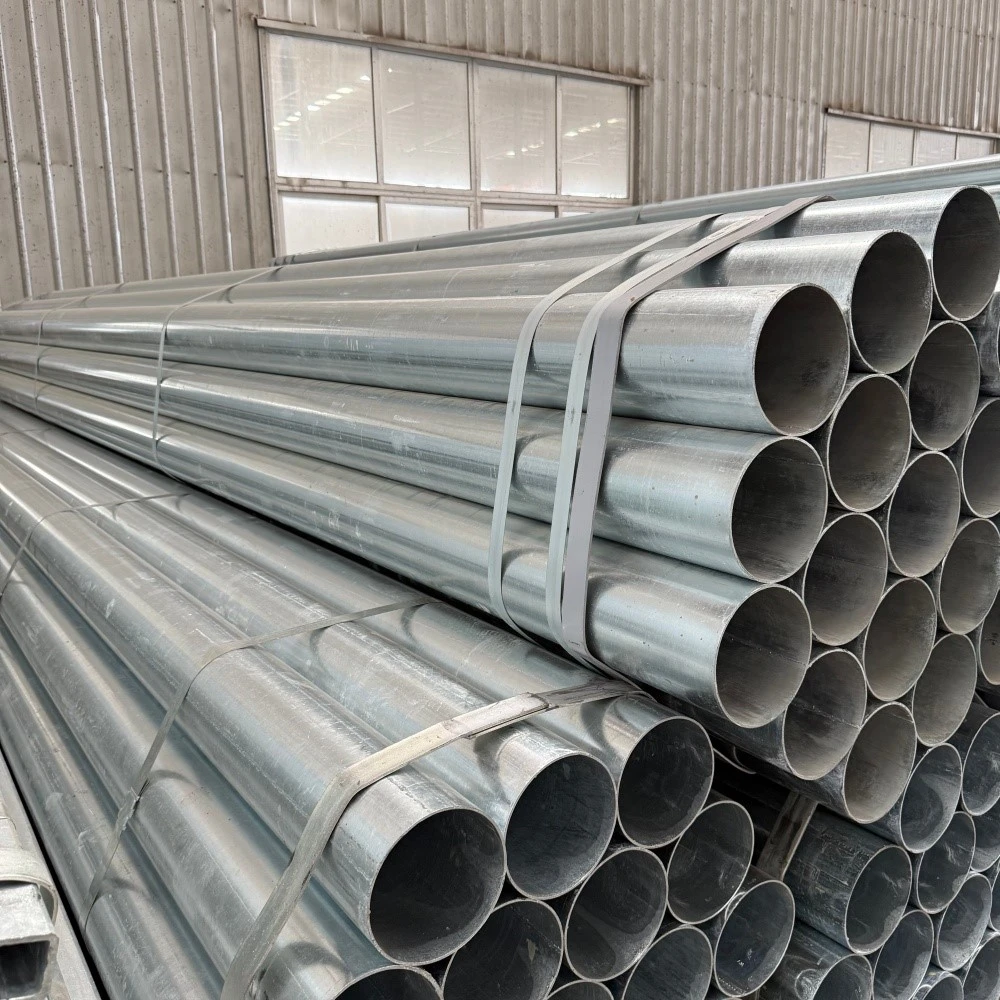
Same pipe, same dimensions, three different coating worlds.
ASTM A123 / A123M applies to pipe that is fabricated first and dipped afterwards. Coating thickness is graded by steel thickness, from roughly 45 µm on light sections to 85 µm and up on heavy ones, averaged over the lot with a defined minimum for any single reading.
EN ISO 1461 does the same job for the European market, with four bands:
|
Steel thickness |
Mean minimum |
Local minimum |
|
< 1.5 mm |
45 µm |
35 µm |
|
1.5 – 3 mm |
55 µm |
45 µm |
|
3 – 6 mm |
70 µm |
55 µm |
|
> 6 mm |
85 µm |
70 µm |
A 4 mm wall pipe therefore sits in the 70 µm band. A 6 mm and above wall goes to 85 µm. If a tender cites "hot-dip galvanized" without a band, the supplier is free to aim at the bottom of the table, and 45 µm on a 4 mm pipe is a legitimate reading under a loose reading of the spec.
ASTM A153 covers threaded fittings - couplings, nipples, bushings - separately, because threads are cut after dipping and the cut exposes bare steel at the root. This is why the pipe can pass and the coupling still rusts in the joint.
ASTM A653 / EN 10346 is a different product altogether: coil that was coated before it became a pipe. Z275 means 275 g/m² total across both surfaces, which is about 19 µm per side. Nineteen microns is not a pipe coating. It is a coil coating that happens to be on a pipe.
Layer 3, the approval: whether it may be installed
A pipe can be perfectly manufactured to A53 and still be rejected on site, because the authority having jurisdiction answers to a different document.
Fire protection in most Gulf and Asian markets: hot-dip galvanized is mandatory for wet systems by civil defence, and the sprinkler components carry UL/FM listing that attaches to a specific factory and line, not to a brand. Scaffolding in Europe: EN 39 fixes the 48.3 mm OD and the 3.2 mm wall, and the tube is not sold by Schedule at all. Structural work in the EU: EN 1090 execution class decides the inspection regime before anyone discusses zinc.
Three layers. Product standard, coating standard, approval. A quotation that names only one of them is incomplete by definition.
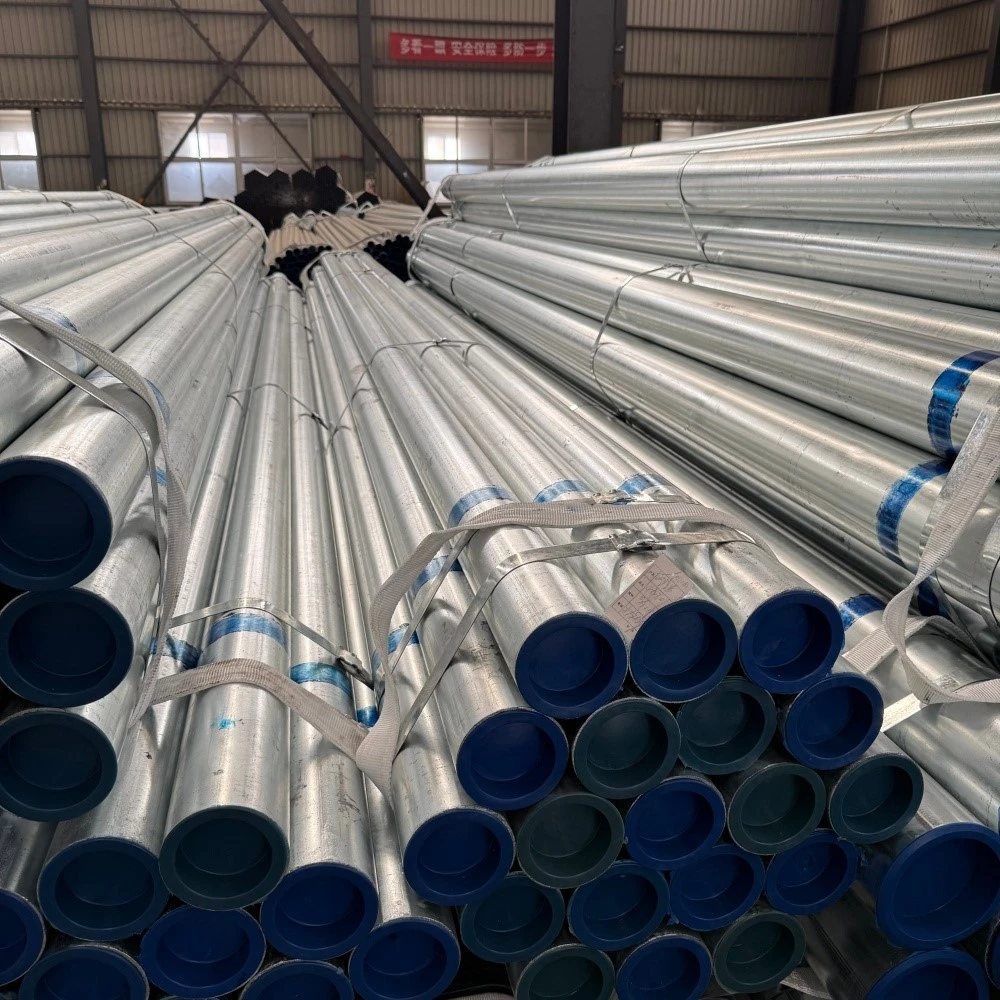
The five mismatches that actually generate claims
1. A53 quoted for a coastal or structural job. The buyer's real requirement was durability; A53 answers a dimensional question. The correct move is to keep A53 for dimensions and add A123 or ISO 1461 for the coating, and write both numbers into the PO.
2. Pre-galvanized sold as hot-dip. This one survives because it is arguable. The coil was genuinely hot-dip coated at the steel mill. The phrase is technically true and commercially misleading. The tell is the weld seam: after forming and welding, a pre-galvanized tube carries a 4–8 mm strip of bare steel running the full length, inside and out. Look inside the pipe with a torch before you accept the bundle.
3. EN 10255 Medium substituted with Schedule 40. Close in wall, not identical. Medium wall is specified to its own table, and the coupling is machined to that table. Mix the two and the thread engagement changes, which shows up as leakage under test rather than as a dimensional failure.
4. The DN trap. DN 65 exists as 76.1 mm in the DIN/ISO world and 73.0 mm in the ASME world. DN 100 is 108 mm in press-fit systems and 114.3 mm in threaded and grooved systems. A grooved coupling for 73.0 mm will clamp onto a 76.1 mm pipe, feel correct under the torque wrench, pass a visual check, and weep three months later. Always specify the outside diameter in millimetres, and name the series.
5. Thread standard left as "standard thread". At 1/2", NPT and BSP both run 14 threads per inch with a different flank angle. They engage two or three turns, then either seize or leak. On a gas line, that is not a warranty issue.