Search for a galvanized coil and you will meet a wall of codes: DX51D+Z, DX52D+Z, S250GD, +AZ, +ZM. Suppliers quote them as if the letters were self-explanatory. They are not, and the gap between what the code means and what buyers assume it means is where most flat steel disputes start.
This article decodes the naming system, walks through the full grade ladder, and gives you a selection path you can apply to your own part drawings before you send an enquiry.
1. Reading the code, letter by letter
Take DX52D+Z as the example.
D - the steel is a flat product for cold forming. This is the "drawing" family, not the structural family.
X - the rolling condition of the substrate is not specified. The mill can start from hot-rolled or cold-rolled substrate and still call it DX. (A "DC" name would commit to a cold-rolled substrate; DX does not.)
52 - the position on the forming ladder. Higher numbers draw deeper.
D - the steel is continuously hot-dip coated (D for dip).
+Z - the coating is zinc. Other suffixes exist: +ZF, +AZ, +ZA, +ZM - more on those below.
So DX52D+Z reads: a cold-forming flat steel, substrate rolling condition unspecified, second-level formability, continuously hot-dip coated with zinc, under EN 10346.
Two things follow from that decoding. First, "DX52D+Z" without the standard reference is incomplete - the same word string does not exist in ASTM or JIS, so quoting the standard (EN 10346) in the enquiry prevents half of the grade confusion before it starts. Second, the 52 tells you about formability only. It tells you nothing about corrosion resistance. That lives in the coating weight - Z140, Z275 - which buyers routinely merge into the grade in their heads, and suppliers routinely let them.

2. The forming ladder: DX51D to DX54D
The EN 10346 forming grades are four steps, and each step buys ductility with chemistry and processing:
|
Grade |
Forming capability |
Typical parts |
|
DX51D+Z |
Bending, profiling, roll forming |
Roofing, decking, ducting, fence rails |
|
DX52D+Z |
Drawing, moderate deep drawing |
Appliance panels, lamp housings, cable tray channels |
|
DX53D+Z |
Deep drawing |
Deep-drawn housings, complex shells |
|
DX54D+Z |
Extra-deep drawing, IF steel |
Automotive-class body parts |
The step you should care about is the one between DX51D and DX52D, because that is where most mistakes happen - in both directions.
Buying DX51D when the part needs DX52D shows up on the press as stretcher strains: fine parallel lines on the panel surface, visible after paint, on a part the drawing calls "shallow". The coil is chemically fine. The grade is one rung too low, and no inspection before shipping would have caught it, because the failure only appears when your die works the metal.
Buying DX52D when the part only needs DX51D wastes roughly USD 10–25 per tonne `` on ductility a roll-former will never use. Profiled roofing and corrugated sheets are DX51D parts. Paying for 52 gets you nothing but a nicer number on the certificate.
3. The coating suffixes: +Z is not the only option
The letter after the plus sign is the coating metal, and each one changes the behaviour of the sheet:
+Z (zinc) - the standard. Galvanized, sacrificial protection, the cheapest per micron of real protection. This is what most buyers mean when they say "galvanized".
+ZF (zinc-iron alloy) - galvannealed. Matte grey, fully paintable, harder surface that resists flaking during severe forming. Common on automotive and painted appliance stock. Welds better than +Z.
+AZ (55% aluminium-zinc) - Galvalume-type. Far better heat and atmospheric barrier performance; less sacrificial at bare cut edges. The construction favourite for roofing in hot climates.
+ZA (zinc-aluminium) - a middle path: better corrosion life than +Z, still mostly sacrificial.
+ZM (zinc-magnesium) - the newest and the strongest performer per gram. Self-healing at cut edges, dramatically slower red-rust onset, and priced accordingly. Worth shortlisting for solar structures and coastal exposure.
A common error is treating these as interchangeable "galvanizings". They are not. +AZ and +Z behave differently at cut edges; +ZF paints differently from +Z. If your customer's spec says galvanized and your quote says +AZ, you have quoted a different corrosion system.
4. The structural family: S250GD and up
If the first letter is S, the steel is structural: S250GD, S300GD, S350GD, up to S550GD. The number is the minimum yield strength in MPa. These grades trade formability for strength - exactly the opposite trade to the DX family - and they are the correct grades for purlins, structural profiles, solar mounting rails and anything load-bearing.
The mistake to avoid is substituting across families. A DX52D has a yield band starting at 140 MPa; an S250GD guarantees 250 MPa minimum. Putting a forming grade where a structural grade belongs is not a coating problem, and it will not be visible at delivery. It will be visible in the deflection.
5. How to pick: a path you can walk with a drawing in hand
Work through these questions in order. Stop at the first answer.
1. Does the part carry load?
Yes → the S family, matched to the design yield (S250GD for most framing, S350GD and above for lighter, stronger profiles). No → continue.
2. How does the part get formed?
Roll-formed, corrugated, bent on a brake → DX51D
Drawn or moderately deep-drawn - appliance panels, trays, channels → DX52D
Deep-drawn shells → DX53D
Automotive-class deep draw → DX54D
3. What environment does the finished part live in?
Indoors, painted, appliance or furniture → Z90–Z140, zero spangle, surface treatment matched to your paint line
Outdoor, unpainted, temperate → Z275
Outdoor, hot-dry or coastal → shortlist +AZ or +ZM before accepting +Z
Buried, immersed, permanently wet → stop; continuous galvanized sheet is the wrong product family - take hot-dip-after-fabrication instead
4. Does the coil get painted?
Then zero spangle and a declared surface treatment (C, O or CO) go into the specification - a regular spangle will telegraph through thin paint, and a mismatched passivation will fight your pre-treatment chemistry.
One more habit worth building: put the coating weight and the grade in separate fields of the enquiry. "DX52D+Z" tells your supplier how the metal forms. "Z140" tells them how long it survives. Merging the two into one string is how orders get confirmed with the wrong coating and nobody notices until the claim.
6. Two quick FAQ
Q: Is DX52D+Z the same as ASTM A653 CS Type B?
A: Approximately - CS Type B is the closest ASTM drawing-quality grade, and JIS SGCD-class is close as well. But "approximately" is the operative word: chemistry windows and test methods differ, and substituting across standards without a die trial transfers the risk to you. Verify with your forming process before switching.
Q: Can I upgrade the grade for free if stock is short?
A: Sometimes, in one direction: a mill holding DX53D can often supply it against a DX52D order, because higher formability covers lower. The reverse is never true, and neither direction is free on structural grades - do not accept an S250GD order supplied as DX52D, whatever the covering note says.
Closing
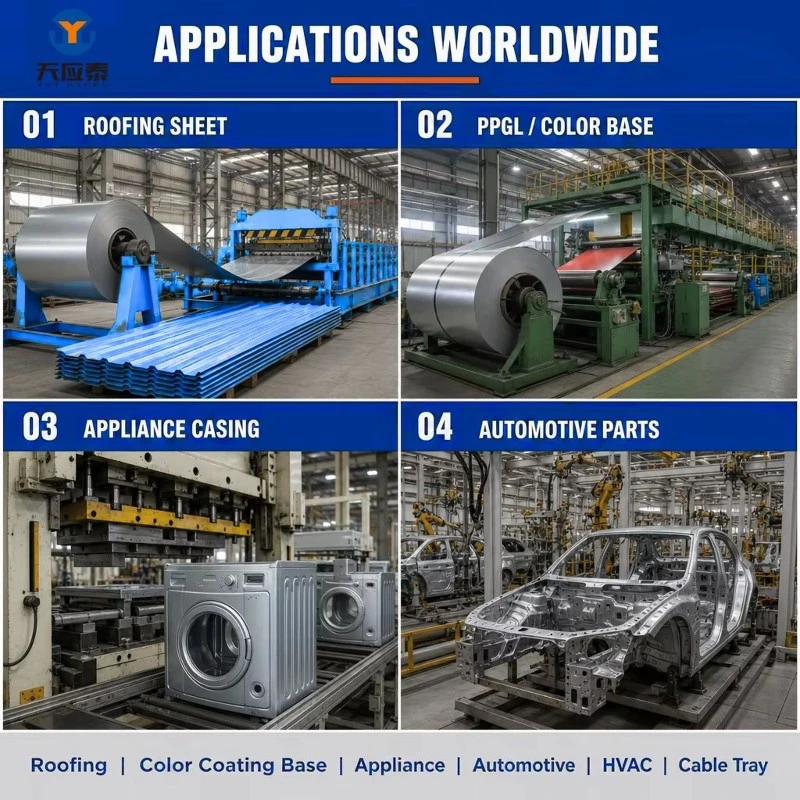
The code is a compact specification once you can read it: family, formability, coating metal, coating weight. DX52D+Z means a second-step forming grade, zinc-coated, under EN 10346 - and whether it is the right grade for you depends on the part, the press and the environment, not on the number looking familiar.
If you are sourcing 0.5 × 1250 mm stock for appliance or panel work, our DX52D+Z galvanized steel coil page carries the full specification, coating cost math and processing options. The coating-weight figures referenced above are decoded in more depth in g/m², µm and the standard numbers.