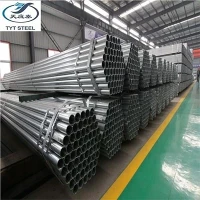
Fire protection piping is the one part of a building where "close enough" is not close enough. The pipe almost never fails on its own. What fails is the joint, the coating, or - far more often than anyone admits before it happens to them - the size series.
This guide covers the four decisions that actually determine whether a galvanized fire pipe order works on site: the connection method, the size series, the wall thickness that goes with it, and the coating. It is written for importers, contractors and consultants buying from mills, and it assumes the pipe is for sprinkler systems, hydrant lines, standpipes or hose reels.

1. Start with the connection, not the pipe
The single most common mistake in fire pipe sourcing is choosing the pipe first and the jointing method last. It is backwards, because the connection method dictates the minimum wall thickness, and the wall thickness dictates which product you can legally install.
Threaded (BSP / NPT)
The oldest method. The thread is cut into the pipe wall, which removes roughly 1.5 to 2 mm of metal at the crest. A pipe threaded at 1.5 mm wall has almost nothing left holding pressure. That is why threaded systems require heavy wall - Schedule 40 under ASME standards, or the "heavy" class under EN 10255. If your drawing shows threaded joints, the thin-wall products in this article are not candidates, no matter how good the price looks.
Grooved (coupling and gasket).
Two half-shells clamp onto rolled or cut grooves near the pipe ends, with a rubber gasket inside. Installation is fast, joints can be disassembled, and vibration tolerance is good. The catch: the groove itself is a cut into the wall. Grooving depth on a DN100 pipe runs around 2 mm. Buy a pipe that is too thin, groove it, and the wall remaining under the groove may be below what the coupling standard allows. Coupling manufacturers publish a minimum wall at the groove - check it against the pipe, not against the nominal size.
Press-fit (collar and O-ring). A pressed collar with an EPDM gasket seals onto the pipe wall. No thread, no groove, no hot work - which means no hot-work permit on site, and no fire watch. This is the fastest system to install and the lightest to ship, because the pipe only needs enough wall to resist the pressing force, not to carry a thread. The trade-off: the system is only as good as the fittings and the press tool calibration, and the pipe is committed. You cannot convert a press pipe to threaded later.
So the first question to answer is not "what coating" and not "what standard". It is: how will this pipe be joined on site? Everything else follows from that.
2. The DN trap: three OD series share the same name
Here is the failure that costs the most and is discovered the latest.
"DN" is a nominal designation, not a dimension. The same DN65 can mean two different outside diameters depending on which series the pipe and the coupling come from:
|
DN |
Press-series OD |
EN 10255 / ISO 65 OD (threaded) |
ASME NPS OD |
|
15 |
18 mm |
21.3 mm |
21.3 mm |
|
20 |
22 mm |
26.9 mm |
26.7 mm |
|
25 |
28 mm |
33.7 mm |
33.4 mm |
|
32 |
35 mm |
42.4 mm |
42.4 mm |
|
40 |
42 mm |
48.3 mm |
48.3 mm |
|
50 |
54 mm |
60.3 mm |
60.3 mm |
|
65 |
76.1 mm |
76.1 mm |
73.0 mm |
|
80 |
88.9 mm |
88.9 mm |
88.9 mm |
|
100 |
108 mm |
114.3 mm |
114.3 mm |
Two rows carry the trap.
DN65. The DIN/ISO series runs 76.1 mm. The ASME series runs 73.0 mm. Both are sold as "DN65" or "2½ inch" depending on who is talking. A grooved coupling machined for 73.0 will seat on a 76.1 pipe about as well as a lid on the wrong jar - the gasket lip sits proud, the clamp torque reads normal, and the joint passes a visual inspection. It will weep under pressure, sometimes months later.
DN100. The press-fitting world (which follows the ISO 1127 dimensional series, the same ODs used on stainless press systems) runs 108 mm for DN100. Threaded and grooved pipe runs 114.3 mm. If a project has press pipe for the branch lines and grooved mains, both will be described as DN100 in the documents, and they are 6 mm apart.
How to avoid it: specify the outside diameter in millimetres on the purchase order, not the DN, and require the same figure printed on the packing list and the mill certificate. One line: "OD 76.1 mm (DIN series), not 73.0 mm (ASME)." It costs nothing to write and one container to ignore.
3. Wall thickness: what each system needs
For the press-fit system, the pipe is engineered thin on purpose. The wall only has to survive pressing, internal pressure and handling. A typical press-compatible carbon steel range looks like this, with weights calculated from the net section:
|
DN |
OD × wall (mm) |
kg/m |
vs DN-equivalent Sch40 |
|
15 |
18 × 1.5 |
0.61 |
−52% |
|
20 |
22 × 1.5 |
0.76 |
−55% |
|
25 |
28 × 1.5 |
0.98 |
−61% |
|
32 |
35 × 1.5 |
1.24 |
−64% |
|
40 |
42 × 1.5 |
1.50 |
−63% |
|
50 |
54 × 1.5 |
1.94 |
−64% |
|
65 |
76.1 × 2.0 |
3.65 |
−58% |
|
80 |
88.9 × 2.0 |
4.29 |
−62% |
|
100 |
108 × 2.0 |
5.23 |
−67% |
Between 52% and 67% lighter than a Schedule 40 equivalent, before you count the fittings. On a DN100 sprinkler main, that is the difference between 16.1 kg/m and 5.2 kg/m - roughly eleven tonnes lighter per kilometre of pipe, which shows up directly in freight, in rigging, and in the speed of installation.
But the thin wall is a boundary, not a bonus:
Never thread it. A 1.5 mm wall cannot carry a thread. There is no version of this where it works.
Never groove it beyond the coupling's minimum. Most grooved couplings want more wall than 2.0 mm minus groove depth leaves. Check the coupling datasheet, not the pipe datasheet.
Do not let the wall be the only spec. Two 2.0 mm pipes are not equal if one is made to a press-system dimensional standard with tight OD tolerance and the other is a general-purpose tube that happens to be 2.0 mm. Press collars rely on OD consistency; a loose-tolerance OD will show up as inconsistent pressing force and, eventually, a joint that was never really made.
For threaded systems, the rule is simpler: Schedule 40 / EN 10255 heavy, full stop. For grooved systems, Schedule 10 is the practical floor, and the wall at the groove is the number that matters.
4. Galvanized, black steel or painted - what the code actually says
The second-most expensive mistake is assuming "fire pipe" means "galvanized pipe" everywhere.
Codes differ by jurisdiction, and they are not trying to agree:
Many Middle East, African and Asian civil defence authorities require hot-dip galvanized piping for hydrant systems, fire mains and standpipes, and frequently for sprinkler systems too. BS 1387 / EN 10255 hot-dip is the historical baseline here. If you are tendering into these markets, the galvanizing requirement is usually written into the specification - but the standard and the coating weight may not be. Clarify both.
NFPA-based engineered sprinkler systems commonly run black steel with grooved joints for wet systems. Corrosion studies over the last two decades changed thinking here: in dry and preaction systems, zinc corrosion products can flake and migrate to the sprinkler orifice, which is a clogging risk, and several specification bodies have restricted where galvanized pipe may be used. The restrictions have moved between editions of the standards, so check the current edition your project cites rather than quoting a rule from memory. On wet systems, black steel remains the default in much of the NFPA world.
Fire mains and yard piping are frequently galvanized or coated regardless of system type, because they sit buried, exposed, or in wet environments for decades.
The practical instruction for a buyer: ask which authority signs off the installation, and work backwards from their document. A shipment of hot-dip galvanized BS 1387 pipe that arrives on an NFPA wet-sprinkler project may be rejected for being over-specified and non-listed - the wrong rejection, but a rejection all the same.
One more point on the internal surface, because it is invisible at delivery and decisive in service: if the system is galvanized, the internal coating is what protects the sprinkler network, not the outside. Pre-galvanized coil products have a coated bore by construction; hot-dip products have a coated bore that can be thinner and uneven inside, especially on small bores where the flux and the drainage of the kettle fight each other. Either way, ask for the coating figure that applies to the bore, stated separately, not folded into a flattering average.

5. The red paint is not the galvanizing
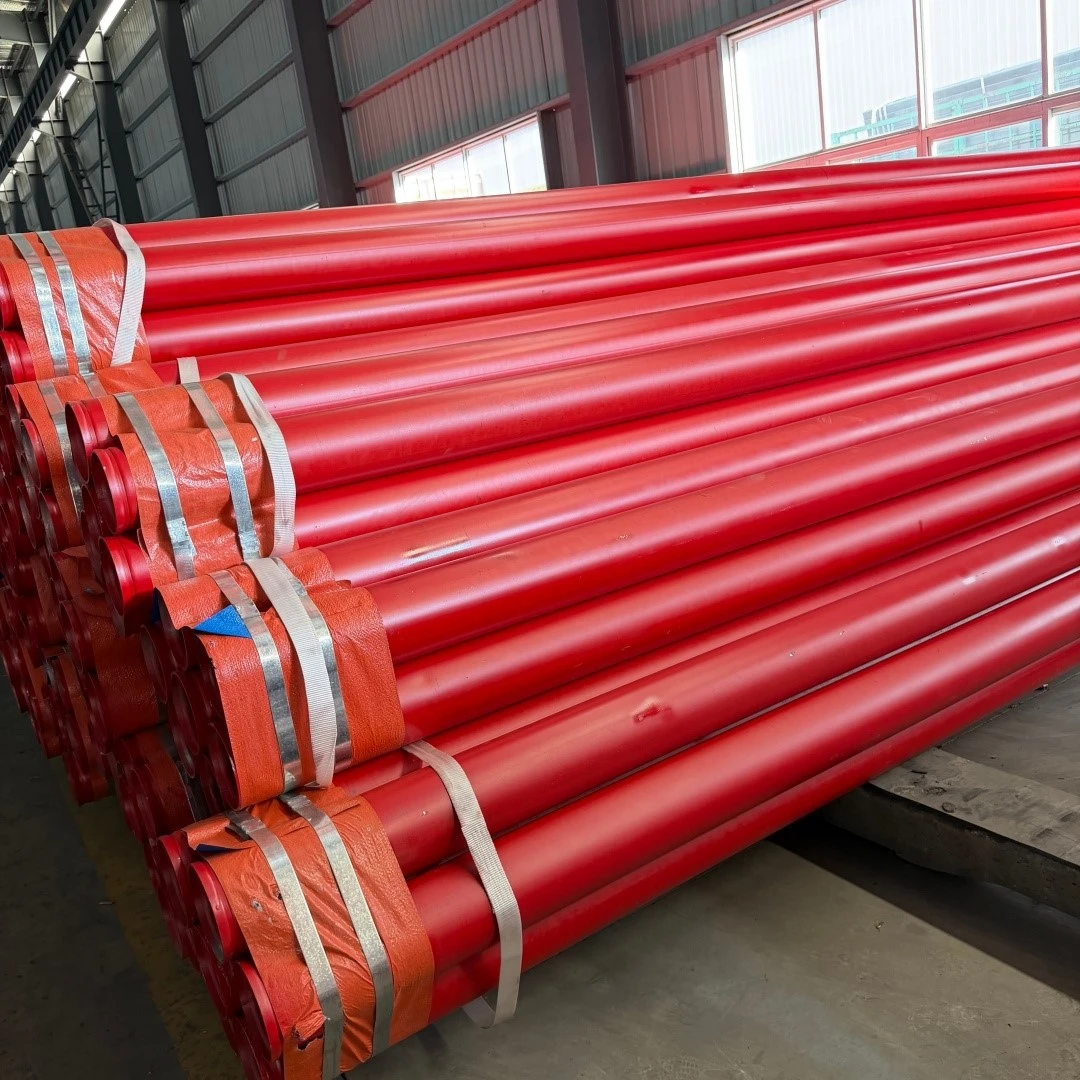
Fire pipe is red. RAL 3000, usually, applied as epoxy or polyester powder. On a galvanized fire pipe, the paint sits on top of the zinc, and the stack-up matters more than it looks:
Hot-dip first, paint second. Painting before dipping does not survive the kettle. Any supplier offering "pre-painted hot-dip pipe" has the process order wrong, or the paint is not on a hot-dip pipe at all.
Adhesion needs surface work. Fresh galvanized steel passivates within days. Paint over an intact passivation layer can lift, particularly at edges and grooves. Serious mills sweep-blast or chemically prepare the surface before powder coating. Ask how; the answer separates the mills that ship painted pipe routinely from the ones that started last year.
Paint hides zinc. Once the pipe is red, nobody on site can verify the coating. That makes the mill certificate and the coating weight report the only evidence - so make them a condition of the order, with the coating weight referenced to the standard, not to the word "galvanized".
Grooves and threads cut through everything. Grooving after painting exposes bare steel in the groove - both the zinc and the paint are gone. Either groove before galvanizing (rarely practical) or require zinc-rich touch-up plus compatible paint repair at every groove. For press systems, the collar covers the joint zone, so the exposed area is smaller but still needs the O-ring seating face clean.
And a small one that shows up as a claim rather than a defect: painted pipe packed damp, or painted over fresh zinc that has not had time to develop, can develop reactions under the paint film. Same logic as white rust - ventilated packs, dry tubes, and no sealed plastic film. We cover the mechanism in detail in white rust on galvanized steel pipe.
6. What to put in the purchase order
A fire pipe order is one of the few steel orders where the specification can be written in five lines and still be complete:
Jointing system: grooved / press / threaded (choose one - and state it first)
Outside diameter in millimetres and series: e.g. OD 76.1 mm DIN series (not 73.0 ASME)
Wall thickness, and wall remaining at groove if grooved
Standard: EN 10255 / BS 1387 / ASTM A795, steel grade, hot-dip galvanized to ISO 1461, internal and external, coating weight reported for each side
Finish: RAL 3000 powder coat over zinc, with zinc-rich repair at grooves and cut ends; hydrostatic test per standard; MTC 3.1 per EN 10204; packing ventilated, dunnage between tiers
Add the commercial framework - which term, which port, and the coating checks that survive transit - using the same discipline we set out in FOB vs CIF vs DDP for galvanized steel pipe. The coating and zinc-thickness figures referenced above are defined in g/m², µm and the standard numbers, which also explains why "galvanized" without a number is not a specification.

7. FAQ
Q1: Why did my DN65 grooved coupling not seal on DN65 pipe?
A: Check both outside diameters. The DIN/ISO series runs 76.1 mm; the ASME series runs 73.0 mm. A coupling built for one will clamp onto the other without sealing. Specify OD in millimetres on the order.
Q2: How long does hot-dip galvanized fire pipe last?
A: Internally, in a wet sprinkler system with treated water, decades. Externally, it follows the ISO 9223 corrosion categories: 55–85 µm of zinc gives 25–75 years in a C3 urban environment, far less at C5 coastal. Internal corrosion in stagnant, untreated water is the real risk, which is why internal coating weight matters more than the exterior finish.
Q3: Is the red paint a substitute for galvanizing?
A: No. Paint over bare steel on fire piping gives you a red pipe with no corrosion protection at the first scratch. Paint is applied over zinc, and the zinc does the work.
Q4: Can I groove hot-dip galvanized pipe?
A: Yes, and it is normally done after galvanizing, which cuts through the zinc in the groove. Require zinc-rich touch-up in the groove plus paint repair. Check the coupling manufacturer's minimum wall at the groove against the pipe's actual wall, not the nominal size.
Q5: What documents should ship with a fire pipe order?
A: Mill test certificate (EN 10204 3.1) with the steel grade and heat numbers, coating weight report stated per side, hydrostatic test record, and packing list with OD figures in millimetres. If listing is required, the UL/FM certificate number and the covered facility.